Saturday, October 28, 2017

What Does the Aftermath of Defeating ISIS Entail?


The US has made a lot of progress in their campaign to fight against terrorism, specifically ISIS in Syria and Iraq. However, in the process, they have practically left these countries in shambles and have directly harmed civilians

The activist journalism group, Raqqa Is Being Slaughtered Silently, has documented more than 3,829 airstrikes and 1,873 civilian deaths throughout battles in the city, and says 450,000 people remain displaced from the city. Additionally, Iraq's own security forces have frequently resorted to brutality against civilians, especially in places like Mosul where ISIS held a stronghold until recently. 

In the wake of all of this chaos, there is no doubt that these countries will need help rebuilding themselves, however, as the article "America's successful campaign to defeat ISIS militarily has a glaring 'Achilles heel'" writes, "the "Achilles heel" of the US-led coalition's strategy is that it makes no preparations to resolve these complex problems, and focuses solely on a military victory over ISIS". Therefore, the US has only been concerned about winning and defeating ISIS thus far, with virtually no plans as to how they will solve the possibly bigger problems of political instability in the aftermath of these attacks. 

Solving these problems would require devoting even more military aid and time to these countries that may pose a burden on the US, but, without this aid, these countries may struggle to rebuild and may be even more vulnerable to future terrorist group and other attacks. Additionally, Syria and Iraq are divided ethnically between the Kurds, Shiites, and Sunnis (currently the Shiites hold most of the power while the Sunnis are considered the minority group). Therefore, the solution to this problem of political instability and rebuilding must address class struggles within these countries as well. 

Questions:

  1. As Commander in Chief, what powers does the president have over this situation? How would you handle the situation as president?
  2. At what point must we draw the line when trying to fight against terrorism? Is putting an end to terrorism worth all the innocent lives lost and destruction caused in the process? Why or why not?
  3. How can the US help or influence the Shiites in order to maintain order and peace once the fight against terrorism is over in Syria and Iraq (ex: military assistance)?

Sunday, October 22, 2017

Should America Continue to Participate in Foreign Wars?


America's Forever Wars: The Editorial Board

The United States has been involved in many foreign wars since the attack on September 11, 2001. There are American troops almost within every foreign country, with Japan, South Korea, and Germany housing the most.

Many of these forces are engaged in counterterrorism operations — against the Taliban in Afghanistan, for instance; against the Islamic State in Iraq and Syria; against an affiliate of Al Qaeda in Yemen. So far, Americans seem to accept that these missions and the deployments they require will continue indefinitely. Still, it’s a very real question whether, in addition to endorsing these commitments, which have cost trillions of dollars and many lives over 16 years, they will embrace new entanglements of the sort President Trump has seemed to portend with his rash threats and questionable decisions on North Korea and Iran.

During earlier wars, including Vietnam, the draft put most families at risk of having a loved one go to war, but now America has all-volunteer armed forces. Less than 1 percent of the population now serves in the military, compared with more than 12 percent in World War II. Most people simply do not have a family member in harm’s way.

American casualty rates have been relatively low, especially in more recent years after the bulk of American troops were withdrawn from Afghanistan and Iraq. Also, the United States has shifted to a strategy in which Americans provide air power and intelligence, and train and assist local troops who then do most of the fighting and most of the dying. This year, for instance, 11 American service members died in Afghanistan and 14 in Iraq. By comparison, 6,785 Afghan security force members died in 2016 and 2,531 died in the first five months this year, according to the United States and Afghan governments. Tens of thousands of civilians also perished at the hands of various combatants, including in 2017, but the figures get little publicity. Most Americans tend not to think about them.

Whether this largess will continue is unclear. But the larger question involves the American public and how many new military adventures, if any, it is prepared to tolerate.

Questions:

1. Do you think America is responsible for other democracies' issues? Why?

2. Is there ever a time to send troops to another country (outside of war)? Why or why not?

3. Should there be any restrictions on counter-terrorism, or should terrorism be stopped by "any means necessary"? Why?

FEMA Chief Blamed for Katrina Response Says the Same Problems Are Happening in Puerto Rico


Michael Brown, the former chief of FEMA, makes his comment on what has been happening in Puerto Rico after Hurricane Maria. Brown was widely blamed for the sluggish attitude during the time of Hurricane Katrina, which eventually caused him to resign during the crisis of Katrina. Today, however, he makes note that similar actions are being taken place with Maria. 

Although Brown likes how Trump's administration is handling the situation in Puerto Rico following the hurricane, he says that there are still people in Puerto Rico "who haven't learned that". He comments that the unified command center in Puerto Rico were mismanaging resources and being unhelpful with coordination which made it even harder for officials to make it to Puerto Rico, as it was adding on to the other issue which was that there was destruction on the island as well. David Paulison, the chief of FEMA after Michael Brown, agrees with what his predecessor said. He adds on as well saying it's also due to issues with miscommunication between the federal, state, and local level, assessing that from both Katrina and Maria.

Besides Brown and Paulison's comments, Mike Byrne also comments on the situation but in a more positive sense. Byrne concurs that he is doing all he can at the moment, with his connections with the "highest levels", to get his job done. He also claims that the only reason help to Puerto Rico is so slow is because there has to be a cross from The States to Puerto Rico, rather than sending resources straight there which alone would take time. Even though there are resources there, it is still coming slowly, but Byrne suggests that it will speed up overtime. Despite issues in Puerto Rico, Brown and James Lee Witt, the FEMA director during the Clinton presidency, have heavily complimented Trump on his role with Puerto Rico. Although many are angry with Trump due to his threats about pulling out of Puerto Rico via Twitter, People in Trump's administration, such as Mick Mulvaeny says to focus on what they are doing for the island, not what Trump is stating on Twitter. 

In conclusion, Puerto Rico is struggling to get assistance from the US, and judging by Trump's tweets on the internet and the comments made in this article, history might repeat itself. 

Questions: 

1. Why do you think there is such disorganization within Puerto Rico? 

2. Do you agree with Brown, Paulison, or Byrne? If you do, what do you agree with specifically and why? If not, what don't you agree with?

3. Do you really believe that Trump is doing all that he can to help Puerto Rico after the Hurricane?

Saturday, October 21, 2017

Senate Approves Budget Plan That Smooths Path Toward Tax Cut

Image result for tax cut cartoon donald trump


https://www.nytimes.com/2017/10/19/us/politics/budget-vote-senate.html


After months of dealing with the Affordable Care Act and immigration, tax cuts have finally made it onto the policy agenda. The Republican party has recently made progress in rewriting the tax code with the passage of a budget blueprint that "would protect a $1.5 trillion tax cut from a Democratic filibuster".

Tax cuts are key to the Republican platform and they are going to great extents to make it work. Cuts to spending and other programs need to be severe in order to achieve a balanced budget. In fact, the Republican party intends to cut $1.5 trillion combined from Medicaid and Medicare over the course of a decade. The Senate's blueprint for the 2018 fiscal year claims to achieve a balanced budget within a decade and even greater economic growth. 

Not only do there have to be severe cuts to other programs in order to implement the tax cuts, the tax breaks are more so benefiting the wealthy and corporations than the middle-class. For instance, the plan would eliminate many corporate loopholes and deductions, such as the state and local tax deduction. It would also get rid of many provisions that are currently costly to the rich, like the estate tax and the alternative minimum tax. This has been brought to the attention of several Democratic party leaders such as Chuck Schumer who claims that the tax cuts intend to "give a tax break to big corporations and the wealthiest Americans". Bernie even calls this budget to be "extremely cruel". 

Despite all the recent progress made, the cuts only exist on paper and have not yet been implemented.

Questions:

1. Do you think that this plan is a well thought through plan? Why/Why not?

2. Would this bill create a budget deficit over the next decade?

3. How does the House of Representatives and the Senate budget resolution differ? 

Monday, October 16, 2017

Xi Jinping, the World Leader


Image result for cartoon Jinping

On October 18, 2017, Xi Jinping, China’s president, will open the Communist Party’s congress, an event that occurs every five years. At this event, China’s political delegates from across the nation will convene in China’s Great Hall of the People to review and revise the party’s constitution, and to elect the country’s sectional leaders. It is also possible that Jinping will announce his successor, however unlikely. And while Jinping is positioned to lead for another five years, the event may reshape Chinese politics.
Jinping sees himself as China’s next transformational leader, and plans to increase military spending and establish China as a prominent world power. His primary objective, however, is purely national. He wants to solidify his party’s loyalty. The reshuffling of China’s congress may provide the Communist party, and Jinping, the opportunity to ensure the communist party’s “100% loyalty”.
Jinping’s other objectives, including increased military and state power, may pose a threat to western democracy. Jinping sees democracy as a threat to his leadership. He, aware of the causes of the USSR’s dismemberment, seeks to augment the government’s power over China in order to stay in office. Similar ideologies were seen in the Soviet Union under Stalin, and more recently, in North Korea. Jinping plans to spend billions on other nation’s economies, similar to the US’s Marshall Plan, in order to gain some control over eastern Asia. Additionally, the president is planning to construct more military bases internationally, constructing China’s first permanent international base in Djibouti during his last term. Jinping, now wielding the world’s largest stockpile of foreign currency and largest population under one major party, may step to challenge the U.S.’s status as the foremost world power.
Despite political differences, China and America are not enemies. US presidents have been known to praise Chinese leadership, including many remarks from Nixon, Carter, and Clinton. The U.S. finds its largest trade partner in China, and the U.S. continues to rely on Chinese products in its economy. We must ask ourselves, are we comfortable with the direction China’s leadership is going? And if not, what must we be prepared to lose?

What are the possible outcomes of China’s change in local leadership?

What connections can be drawn between Jinping’s goals and the objectives of the U.S.?

What do you predict POTUS’s response to Jinping’s objectives will be? Why?

Sunday, October 15, 2017

Californians Wonder Why Trump Isn't Tweeting About the Fatal Wildfires


"Where's the President?"


President Donald Trump uses his social media platform (specifically, Twitter) to share his views on subjects concerning religion, mass shootings, natural disasters, and sports. During the course of his election, Donald Trump used his twitter to get attention from the public. In turn, the public adjusted to this form of communication, using Trumps twitter as a resource for information. In this article, author Avi Selk comments on Trump's lackluster response to the wildfires in Northern California.  


Over the past three weeks, CNN counted 16 sports tweets by Donald Trump yet, not one on the issue of California. What does this mean? According to Avi Selk, it may mean that Donald Trump is not interested in the problems California is facing. In addition to Califorinia, Trump did not release any tweets about Puerto Rico. After an accusation arose that Trump did not care, Trump began to share tweets about Puerto Rico. California on the other hand, has still not receieved any tweets.  


As shown in the image provided, people across the world are using their social media platforms to grow awarness for California. According to the article, Californians had only hoped that their president would participate in growing awareness. Unfortunately, Trump has only made one public statement about the wildfires.    


While this article does not necessarily agree with Donald Trump, it is not biased. The author comments on an instance when former President, Barack Obama was golfing at a resort while Louisiana was facing serious floods. For this reason, this is an article is important because it provides information about the California wildwifes, and executive involvment on national issues all through the voice of a politically moderate author. 


Questions: 

1. Has twitter impacted the way people get political information? 

2. Do you think that Donald Trump handled the California wildfires appropriately ?

3. Why is it important for the President to address national issues to the public?


President Trump on Puerto Rico


Trump: ‘We’ll Be There’ for Puerto Rico, a Day After Critical Messages
The issue of federal response to the tragic hurricanes that destroyed Puerto Rico is a controversial issue. Many argue that while the troops and emergency responders are working tirelessly to help however they can, the federal government sent aid too late and not in a large enough amount. Donald Trump’s commentary on this argument raised fear in many, as he stated via Twitter “We cannot keep FEMA, the Military & the First Responders, who have been amazing (under the most difficult circumstances) in P.R. forever!”, just one day after blaming the leadership of Puerto Rico for the disaster that is their economy. People interpreted his tweet as him pulling federal help from Puerto Rico, but it was later made apparent that this was not the case. This was not the first circumstance where Trump’s responses via Twitter have caused havoc in those opposing him. He has tweeted in the past, statements that appeared as if he were blaming the island for the crisis and attempting to refute those who do not believe there has been a strong enough federal response. And, while at times he offers words that restores people’s faith in the government and what they will do for this poor island, Puerto Rico is still in a state of complete disaster. On a positive note, “The House on Thursday approved $36.5 billion more in aid to Puerto Rico and other areas hit recently by natural disasters, adding on to a $15.3 billion relief measure in September.” This immense amount of funds provide hope for the people of Puerto Rico and show that while slowly, aid is coming and increasing.  

  1. What are your thoughts on Donald Trump’s tweets about Puerto Rico?
  2. Is there enough federal help in Puerto Rico?
  3. If it were up to you, what would your method of aiding Puerto Rico be?

Trump Removes Subsidies on ACA

The Battle Over Obama Care

Image result for trump obama care political cartoon
Over the Weekend Donald Trump removes a section of Obama care, giving subsidies to Insurance companies.  These subsidies are given to the insurance companies to lower out of pocket payments by those in need by boosting the companies with money to cut costs. In contrast to this Many senators were currently working to extend these subsidies which the president did away with. His executive order was another hit to Obama care, in an effort to undermine the issue. Donald posted a tweet following this issue trying to bring Democrats to the table for a negotiation almost blackmailing them saying, "If the Democrats were smart, what they’d do is come and negotiate something where people could really get the kind of health care that they deserve," The Democrats seemed unfazed with many saying that they are fairly sure any spike in premiums or prices will fall directly on the Republicans, However, the Republican party is currently split with half fearing this move will hurt their constituents. Chuck Schumer the Democratic leader out of New York mentioned following this repeal of subsidies that "“Unless our Republican colleagues act, the American people will know exactly where to place the blame when their premiums shoot up and when millions lose coverage,” The president has begun to leave lawmakers to fix the issues of Obama care instead of taking the initiative himself.  He has left Congress to debate over what to do next and he wants to slowly take apart the plan. With Republicans still not having another plan in place this could potentially leave millions without insurance. To add the issues we already have the Congressional Budget Office said that if subsidies are cut we can see a spike of 20% in costs for next year's premiums. With this issue being pushed at this time Congress will have to debate in September which leads to a cause of concern for a government shutdown, however many say that they will find a budget for it, given the majority. 


1) Do you think Trump is taking the right course of action? why? 
2) What better alternative is there? why? Whats his mistakes?
3) Do you believe Congress will find a way to negotiate before a possible Govorment shutdown?

Monday, October 2, 2017

The Gun Debate


October 1st, 2017 marks the day of the deadliest shooting in modern America. The Las Vegas massacre killed at least 59 people and injured more than 500. In the wake of this tragedy, the entire country is in mourning, however, Democrats are looking to take action by demanding more gun control laws, whereas Republicans are offering their prayers and condolences, but no real solutions. 
Democrats are saying that offering prayers are not enough. Congresspeople need to learn from this tragedy and take action. However, Republicans are accusing Democrats of politicizing a tragedy. Both parties are approaching this tragedy differently, but there are still people dead and there are still mass shootings that will happen in the future and these debates are not resulting in a practical solution that is going to protect anyone. 
Despite the severity of this shooting, it is predicted that it will not contribute to any meaningful change in gun politics even though public support for more regulation typically spikes after mass shootings.
In fact, with Republicans monopolizing power in the White House and in Congress, chances of reform appear less promising for Democrats than when President Barack Obama failed to do so after the Sandy Hook school massacre in 2012.
Many Republicans sincerely believe their stance on the gun issue and that it is a fundamental aspect of America itself. Additionally, the NRA plays a major role in American politics and can pose a threat to Republican congresspeople if they do not support the NRA. 
Trump used his campaign to accuse Democrat Hillary Clinton of conspiring to subvert the Second Amendment, in a wildly popular play to the Republican base. Barring some stunning conversion, he is unlikely to start pushing for more restrictive gun laws.
On Monday however, he looked to reach a wider audience, accepting a President's duty to offer solace at times of national trial. He did not, as he has often done -- for instance, after the Orlando massacre last year -- seek to leverage tragedy for political gain. And while his scripted remarks were a perfect match for the moment, it remains to be seen if he will be as apolitical and restrained after he has had time to absorb the quickening Washington debate over the killings.
In the end, gun rights campaigners understand that reform will take years and will begin in states and cities.
But that means outrages like the one in Vegas will not swiftly reshape the political terrain. Democratic Sen. Dianne Feinstein, a longtime champion of stricter gun laws, was asked Monday whether anything will change this time.
"You know, I thought Sandy Hook would. I thought Columbine would. I thought 101 California would," she said. "None of that did."
Questions:
1. Do you think significant gun control laws will ever be implemented in America?
2. How severe would a shooting have to be for politicians to put partisanship aside and come up with a meaningful solution to protect the American people?
3. Just because something is in the Constitution, should we follow it word for word? In other words, should the interpretation of the Constitution change with the time and technologies or should it be interpreted as the Founding Fathers wrote it?

Sunday, October 1, 2017

Technology and Politics

  
Google Prepares to Brief Congress on Its Role in Election — Daisuke Wakabayashi, New York Times, September 29th
Facebook to Deliver 3,000 Russian-Linked Ads to Congress on Monday — Mike Isaac and Scott Shane, New York Times, October 1st

Congress has been conducting investigations on how advertising may be linked to Russian interference with the 2016 election. In briefings with the Senate and House Intelligence Committees, Twitter has disclosed that there are about 200 accounts, which is merely "a fraction of the number of potentially compromised accounts found by outside researchers," that seem to have played a role in the Russian influence in the 2016 presidential election. Facebook has found hundreds of accounts that post thousands of ads that relate to Russian interference with the 2016 election. Google has been conducting research on how its ads may connect to Russian interference in the 2016 election. Google has found that some of its services have spread fake news, and in order to combat the dissemination of false news, Google has started Project Owl, which will "provide 'algorithmic updates to surface more authoritative content.'"
Unlike TV, radio, and printed media, the law does not require that companies like Twitter, Facebook, and Google disclose who purchases their ads, but recently, Congress has considered possibly regulating political advertising on the Internet.

Questions:
I. How does technology influence politics? How do you think technology will continue to shape politics?
II. Should the government regulate political advertising? Why or why not?
III. Should companies like Facebook, Google, and Twitter have the responsibility to regulate the content that goes on their sites?

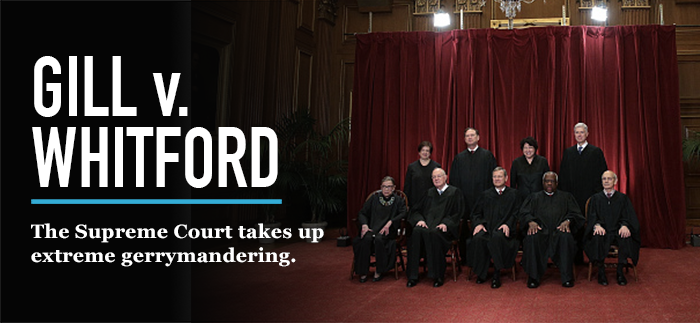
Gill v. Whitford - Gerrymandering in Wisconsin


 Image result for gill v whitford
Wines, Michael. “How a Wisconsin Case Before Justices Could Reshape Redistricting.” The New York Times, The New York Times, 1 Oct. 2017, www.nytimes.com/2017/10/01/us/wisconsin-supreme-court-gerrymander.html?mcubz=3.

The issue of gerrymandering has been around for decades, with no signs of stopping. Until now, gerrymandering has gone, ofr the most part, unchecked across the nation. Because of gerrymandering by Republicans in Wisconsin, a group of Democrats are bringing this issue into the limelight. Once Republicans took control of Wisconsin's legislature in 2010 and redrew the district lines, Democrats have not won more than 39 of the 99 availabe seats even when they had the majority of votes statewide. Because of this, the Democrats are arguing that the redrawing of district lines causes, in this case, the Republican votes to be worth more than the Democrat votes. As of now, the Supreme Court is split with four Justices wanting to impose limits on gerrymandering, and four wanting to let the politicians decide for themselves. The main issue is that there is no way to measure gerrymandering. There is no system that can determine whether one party has drawn the districs too unfairly. It is soley by opinion.

1. Should the system for drawing district lines remain the way it is currently? Why? If not, how can it be changed to better represent the voters?

2. Would it be better to have the federal government take up the job of drawing districs? Would this see the same problem of gerrymandering as it is seen now in the state legislatures?

3. Should district lines remain static or premanent? Why?