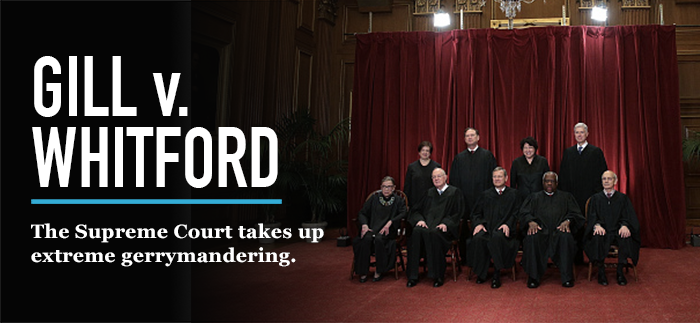
Wines, Michael. “How a Wisconsin Case Before Justices Could Reshape Redistricting.” The New York Times, The New York Times, 1 Oct. 2017, www.nytimes.com/2017/10/01/us/wisconsin-supreme-court-gerrymander.html?mcubz=3.
The issue of gerrymandering has been around for decades, with no signs of stopping. Until now, gerrymandering has gone, ofr the most part, unchecked across the nation. Because of gerrymandering by Republicans in Wisconsin, a group of Democrats are bringing this issue into the limelight. Once Republicans took control of Wisconsin's legislature in 2010 and redrew the district lines, Democrats have not won more than 39 of the 99 availabe seats even when they had the majority of votes statewide. Because of this, the Democrats are arguing that the redrawing of district lines causes, in this case, the Republican votes to be worth more than the Democrat votes. As of now, the Supreme Court is split with four Justices wanting to impose limits on gerrymandering, and four wanting to let the politicians decide for themselves. The main issue is that there is no way to measure gerrymandering. There is no system that can determine whether one party has drawn the districs too unfairly. It is soley by opinion.
1. Should the system for drawing district lines remain the way it is currently? Why? If not, how can it be changed to better represent the voters?
2. Would it be better to have the federal government take up the job of drawing districs? Would this see the same problem of gerrymandering as it is seen now in the state legislatures?
3. Should district lines remain static or premanent? Why?

3. The district lines should not remain static because overtime, both the population and demographics of an area change. At the same time, it is important that the ability to redraw the lines of a district be taken out of the party's control and given to a less bias group, possibly even a computer program, as was mentioned in the New York Times article, "How a Wisconsin Case Before Justices Could Reshape Redistricting". Another option could be to create a new committee with half Democrats, half Republicans, that had to approve new district lines before they were drawn. This may only make it harder to get things done, but regardless, it is important to keep redistricting, but figure out a more fair way to do it.
ReplyDeleteThe system of redistricting should not remain how it is currently. Instead, politics should be removed from the process of redistricting in order to avoid having those drawing district lines from drawing them to their advantage. It is unrealistic to expect those in charge of redistricting to remain objective when drawing lines so instead, it would be more fair and accurately representative of citizens’ political views to mimic California's system of having independent commissions responsible for redistricting as opposed to state legislatures.
ReplyDelete1.)
Delete1. I believe that the system for drawing district lines should not remain the way it is currently. There is a constant tug-of-war game being played between the Democrats and the Republicans for who wins legislature and when the momentum is on one side, it's all downhill from there. This skews the entire system, representing population horribly through the bias of the party. This can easily be changed to better represent the voters. There should be a computer program that redraws by accurately dividing the populations disregarding party identification. Then there would literally be no debate over gerrymandering and also redrawing should happen much more frequently... in order to have a system that is as least biased as possible there is no point not to draw more often
ReplyDeleteFederal government would have limited authority to take over drawing the actual districts. Constitution is vague on how lines are drawn, but precedent establishes the states as the "drawer."
ReplyDeleteDistrict lines should never be made permanent. Although populations and distributions of people are not likely to change in a span of a few years, they certainly will change over a matter of decades. That's why there's a census that happens quite occasionally to begin with. Sure, the Supreme Court is supposed to be neutral, but it simply is not. Redistricting needs to be controlled by an independent committee that must be extensively regulated/checked for bias.
ReplyDelete3. District lines should not be permanent or static, as populations shift. However, district lines that are currently redrawn by state legislators could instead be drawn in some form by public opinion. Perhaps the number of voters is the only way districts are created-- minority-majority groups would be mostly removed, as districts would be determined by voters.
ReplyDeleteThis comment has been removed by the author.
ReplyDelete3. It would be unreasonable for district lines to be permanent. Over time, demographics change. When district lines do not change with population/demographic shifts, certain groups of people's votes stop counting. For example, in Baker vs. Carr Tennessee hadn’t redistricted since 1901 and voting was becoming bias because demographics shifted from almost everyone living in the country, to black people moving to the city and white people staying in the country. The lack of redistricting gave more power to the white folks.
ReplyDelete2. I do not think turning over the responsibility to draw district lines to the federal government would solve the problem of gerrymandering. Although a state's governor and senator party identification may have an impact on bias, the federal government can still hold these same biases that lead to gerrymandering.
ReplyDelete3. Keeping the district lines permanent would never work, because after the census every ten years, representatives are reallocated based on shifts in the population. If congressional boundaries remained static,states with significant population growth would be underrepresented.
ReplyDelete3. District lines should never be permanent as growth in cities fluctuates constantly. Part of the reason we have a census is to re evaluate if cities have grown or shrunk. Many cases have come into play when districts are not redrawn properly or often enough creating misrepresentation and underrepresentation.
ReplyDelete3.) Districts should not remain static, but should also not reconfigured every ten years to give certain parties a political advantage. I believe that independent commissions that draw district lines based on population movement are the best bet at creating dynamic, unbiased districts.
ReplyDelete3. I agree it's a complex issue, but I think we can all agree on the fact that distrust should not stay static because over time, the populations of certain areas change dramatically. If districts remained static, the "one vote one person" ideal would no longer be met.
ReplyDelete3. District lines should definitely not remain static. Over the course of US history, demographics of different areas have drastically changed (like when African Americans migrated north). District lines must change in order to represent demographics accurately. This would allow for better representation and more equal voting.
ReplyDelete